The most efficient disappointment is always yourself.
There is a disappointment more efficient than any other. It requires no external audience, no tribunal, no revised projections from people who love you in the particular way that makes things worse. It runs entirely on internal infrastructure: the daily comparison between what you believed you would become and the person currently loading the dishwasher. It is available at all hours, costs nothing, and scales indefinitely. The Institute has studied many varieties of disappointment. This one is the most loyal.
The self-hatred this produces is, the Institute acknowledges, an impressive achievement. To have internalised an impossible standard so thoroughly that you can administer your own annual performance review, mark yourself inadequate across all categories, and file the report with no outside assistance, this is, if nothing else, a form of self-sufficiency.
The responses are well-documented:
Avoidance: work more, scroll more, drink more, stay busy enough that the gap between projected and actual self never gets a quiet moment to speak. The most popular option, and the least effective.
Comparison: check what everyone else is doing, feel worse, repeat. Social media has industrialised this process considerably.
Productivity as penance: optimise everything, hit the gym at 6am, read the right books, take the right course, treat self-improvement as self-punishment disguised as progress.
Wellness consumption: yoga, breathwork, cold exposure, journaling, the life coach. Not useless, but operating entirely at the level of symptoms. The underlying belief that you are fundamentally inadequate is not a flexibility problem.
Numbing: various substances, various screens, various relationships that ask nothing and offer distraction. Effective short-term. Compounding the original problem indefinitely.
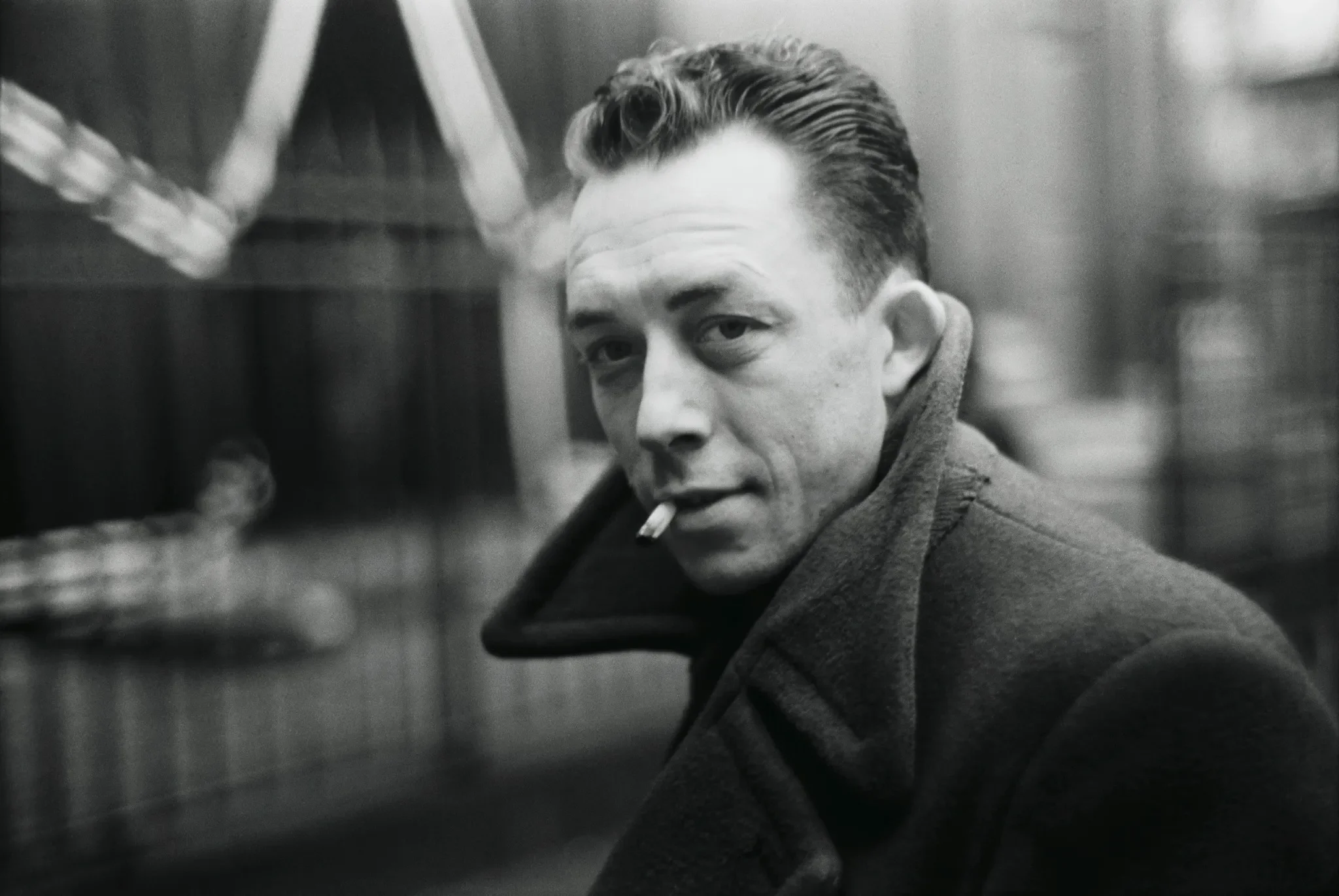
Camus uses the myth of Sisyphus, condemned to roll a boulder up a hill forever, only to watch it fall back down, as a metaphor for the human condition: we seek meaning in a universe that offers none.
This tension between our need for meaning and the world's silence is what Camus calls the absurd. His conclusion: we must imagine Sisyphus happy, defiance and full engagement with the struggle is the meaning, not a means to it.
Camus, who charged nothing and had no retreats to sell, proposed that we must imagine Sisyphus happy. Not because the boulder stops, but because at some point he looks at the rock and recognises it as his. That recognition does not arrive through a subscription tier. It emerges from the slower and considerably less aesthetically pleasing work of sitting with someone qualified to help you examine where the premise came from, who installed it, and whether it was ever accurate. This is not transformation. It is not a breakthrough. It is a gradual and undramatic reduction in self-criticism.
For most people, this is too slow and too unglamorous to attempt. There is yoga. There is breathwork. There is a coach who will reframe the narrative at a rate of €150 per hour. None of this is wrong. The dishwasher still needs loading.