

A serie of short reflections on the Worldcup 2026
The Beautiful Disappointment.
Football is the most popular sport in the world. Children grow up wanting to play it. Adults grow old watching others fail to. The Institute has been observing this for some time.
What follows is not a critique of football. It is a documentation of what football has become: a container for meaning in a period when meaning is difficult to source elsewhere. The corruption, the economics, the aesthetics, the sociology of the loss that feels personal and isn't — these are not problems to be fixed. They are features of a system working exactly as designed.
The Beautiful Disappointment is a five-part series on what football is actually for, who it actually serves, and why you will watch the next match regardless of what you read here.
The Institute does not expect these articles to change anything.
The one-way contract
The Millionaire Who Did Not Deliver
By Dr. Finn Ruyters, Senior Fellow in Relational Disappointment & Affective Entropy
At some point during the tournament, a player earning more per week than most people earn in a decade will misplace a pass. He will fail to convert. He will, in the estimation of several thousand strangers, have let everyone down. The strangers will feel this personally. The player will not.
This is the structural disappointment at the centre of professional football fandom. You have assigned emotional responsibility to someone who did not agree to carry it. The contract runs one way. You invested; he trained. You needed; he performed, or did not. The asymmetry was always there. It simply becomes visible in the moments of failure, when it turns out the transaction was never mutual.
The Institute notes that this is not the player's fault. It is not yours either. It is the logical outcome of a system that sells belonging and delivers employment. The millionaire does not owe you the feeling you paid for. He owes the club ninety minutes. What you do with the gap between those two things is, unfortunately, your own business.
A revenue mechanism you can wear
The Shirt
Dr. Beatrice Lau, Head of Cognitive Recalibration & Energy Transition Anxiety
At some point in the last thirty years, the football shirt stopped being a garment and became a communication strategy. It now communicates several things simultaneously: corporate partnership, synthetic fibre technology, the emotional availability of a grown adult, and a number that has no functional relevance to anything happening in the stands. It does this in colours that were selected by a committee and approved by a brand manager who has never attended a match.
The Institute has reviewed the aesthetics. The gradients, the geometric subpatterns visible only in direct sunlight, the sponsor logo scaled to dominate the chest of anyone who paid to wear it. These are not design failures. They are the honest expression of what the shirt actually is: a revenue mechanism that the consumer has agreed to display on their body, at their own expense, while publicly declaring loyalty to a set of outcomes they cannot influence.
The shirt is the clearest object in football. It tells you exactly what the relationship is. You are wearing their name. They are not wearing yours.
Corruption as architecture
What You Are Actually Looking For
Dr. Otto Klein, Research Fellow in Applied Nihilism & Existential Data Ethics
FIFA has been corrupt for decades. This is not a finding. It is a filing. The bribes, the host nation selections, the governance structures designed to make accountability structurally impossible have been documented, prosecuted, and in several cases celebrated with additional tournaments. The organisation continues. The World Cup continues. You continue watching.
The Institute does not find this surprising. What you are looking for when you watch a football match has never been football. It is meaning. Belonging. The briefly available sensation that something matters and that you are on the correct side of it. FIFA understood this before you did. It built an infrastructure around your need and monetised it at scale. The corruption is not incidental to the product. It is the architecture.
You are not watching a sport. You are watching a container for feelings you cannot otherwise place. The container is corrupt. The feelings remain yours. The Institute recommends noting the distinction.
The formula and its update
Bread and Games
Dr. Salma Qureshi, Director of Strategic Futility & Institutional Burnout
The Roman formula was straightforward. Keep the population fed and entertained and the more structural questions become manageable. The modern version requires neither bread nor games in any meaningful sense. A screen, a subscription, and a tournament schedule maintained across eleven months of the year is sufficient. The population feeds itself. The games run continuously.
This is not a conspiracy. It does not need to be. The arrangement is too convenient for too many parties to require coordination. Governments enjoy a population that processes its frustrations through a referee's decision. Broadcasters enjoy a product that manufactures urgency on a weekly basis. Sponsors enjoy the emotional intensity that makes a logo placement worth more than the logo. The fan enjoys ninety minutes in which the complexity of the world reduces to a scoreline. Everyone gets what they need. The system continues.
The Institute does not suggest that football is a distraction from more important things. It suggests that the distinction between football and more important things has become difficult to locate. The match feels urgent because urgency is what it is designed to produce. The outrage after a loss feels political because outrage after a loss and political outrage are now processed by the same infrastructure. What you do with that observation is, as always, your own business.
The games are not the problem. The bread ran out some time ago. The games continue regardless.
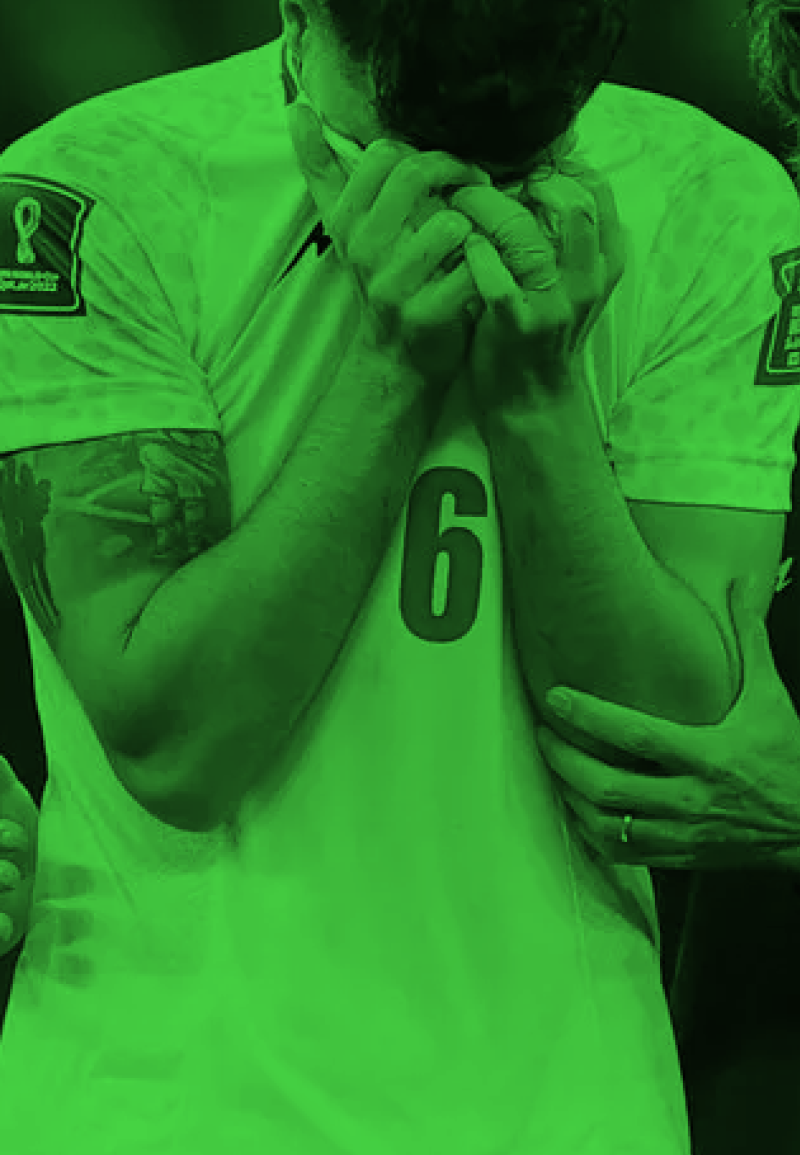
How belonging ends
The Shallow Effect
Dr. Milo Hartmann, Head of Emotional Forensics & Everyday Grief Metrics
Fandom is not irrational. It is efficient. It allows large numbers of people to share an emotional experience without the inconvenience of knowing each other. The stadium, the bar, the living room are spaces where grief and joy become briefly collective, where the individual's need for meaning borrows against the group's. It costs very little to join. It costs more than expected to leave.
What happens after a loss is sociologically interesting and personally inconvenient. The shared feeling inverts. The collective that briefly made the loss bearable becomes the audience for each member's individual processing. The man next to you in the bar is no longer a fellow sufferer. He is a mirror you did not ask for. The disappointment that felt communal at ninety minutes becomes private by midnight.
The Institute's position is that this inversion is the actual product of fandom. Not the win. Not even the loss. The moment after the loss, when you look around and discover that no one is going to resolve this for you, and that you are going to have to take it home and live with it: that is what the whole apparatus was building toward. The group gathered you in order to be present at the moment it released you. This is what community has always done. It is disappointing in a way that is almost structural. The Institute has a desk for that.